
 Market Research Future
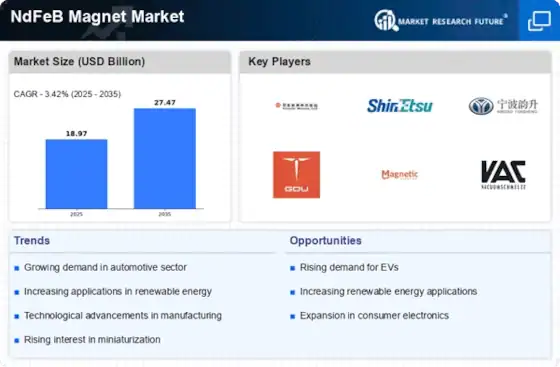
The global NdFeB Magnet Market has evolved into one of the most critical components in advanced engineering sectors, particularly electric vehicles, wind power generation, robotics, industrial automation, and consumer electronics. These neodymium-iron-boron magnets are renowned for their exceptional strength-to-weight ratio, high performance, and unmatched efficiency, making them indispensable for next-generation technologies. According to Market Research Future, the NdFeB Magnet Market was valued at USD 18.97 billion in 2024 and is projected to reach USD 27.47 billion by 2035, growing at a 3.42% CAGR from 2025 to 2035. This steady growth reflects rising adoption across renewable energy systems, automotive electrification, and automation infrastructure.
Market Drivers
- Rapid Growth of Electric Vehicles (EVs)
The EV industry is the strongest driver of NdFeB magnet demand. Permanent magnet motors using NdFeB provide higher power density and efficiency than induction motors, making them ideal for EV performance improvement and battery optimization. As global governments accelerate electrification policies, magnet demand continues to surge.
- Increasing Wind Energy Installations
Direct-drive wind turbines rely heavily on NdFeB magnets due to their reduced maintenance costs and high efficiency. Expanding renewable energy targets in China, the US, Germany, and India create a long-term growth base for the market.
- Miniaturization of Electronics
Smartphones, wearables, speakers, HDDs, and sensors integrate NdFeB magnets to reduce size while increasing output. As the consumer electronics market grows, NdFeB usage expands in audio systems, vibration units, and precision motion components.
- Robotics and Industrial Automation
Global automation across logistics, manufacturing, and healthcare is propelling demand for compact and powerful motors that use NdFeB magnets. Autonomous robots, drones, and CNC machines heavily rely on high-strength magnetic components.
Get a Sample PDF Brochure of the Report https://www.marketresearchfuture.com/sample_request/25700
Regional Analysis
Asia-Pacific – Dominant and Fastest Growing Region
Asia-Pacific leads global production and consumption, with China representing over 80% of the world’s rare-earth magnet manufacturing capacity. Strong demand in EVs, robotics, and renewable energy keeps the region at the forefront.
North America – Rising Demand for EVs and Clean Energy
The US and Canada are increasing focus on local EV manufacturing, renewable energy technology, and reshoring rare-earth supply chains, strengthening regional demand.
Europe – Strong Environmental Policies Driving Growth
European nations are aggressively transitioning toward green energy and EV adoption. Automotive giants like Volkswagen, BMW, and Renault fuel NdFeB magnet requirements.
Middle East & Africa & Latin America – Emerging Opportunities
Although slower in adoption compared to developed markets, increasing industrialization, wind projects, and electronics usage contribute to market growth.
Market Objectives
- Enhance supply chain independence by reducing reliance on rare-earth mining regions.
- Improve magnet efficiency through advanced sintering and coating technologies.
- Support global sustainability goals by implementing recycling processes for rare-earth materials.
- Drive cost optimization through streamlined production and material substitution.
- Accelerate adoption across EVs, renewable energy, and electronics industries.
Key Players
Prominent companies operating in the global NdFeB magnet industry include:
- Hitachi Metals Ltd.
- Ningbo Yunsheng Co. Ltd.
- Shin-Etsu Chemical Co. Ltd.
- Vacuumschmelze GmbH
- TDK Corporation
- Zhejiang Innuovo Magnetics Co. Ltd.
- Guangzhou Golden South Magnetic Technology
- Adams Magnetic Products
- Electron Energy Corporation
- Metglas Inc.
These companies focus heavily on R&D to improve magnet strength, thermal resistance, and durability while exploring rare-earth recycling technologies.
Challenges Facing the NdFeB Magnet Market
- Raw Material Supply Risks
Global production heavily depends on China for neodymium and dysprosium, creating geopolitical vulnerabilities and potential price volatility.
- Environmental Concerns
Rare-earth mining and refining produce radioactive waste and large-scale environmental disruption, prompting stricter regulations.
- High Production Costs
Advanced machining, sintering, coating, and handling requirements make NdFeB magnets expensive compared to ferrite and alnico alternatives.
- Competition from Alternative Technologies
Motor manufacturers are experimenting with induction motors, ferrite-based motors, and rare-earth-free magnet solutions to reduce dependency.
- Recycling Limitations
Although rare-earth recycling is emerging, current processes remain costly and technologically complex.
Buy Now @ https://www.marketresearchfuture.com/checkout?currency=one_user-USD&report_id=25700
Market Segmentation
By Type
- Sintered NdFeB Magnets
- Bonded NdFeB Magnets
- Hot-pressed/HIP NdFeB Magnets
By Application
- Electric Vehicles
- Wind Turbines
- Consumer Electronics
- Robotics & Automation
- Medical Devices
- Industrial Machinery
- Aerospace & Defense
By End-Use Industry
- Automotive
- Energy & Power
- Electronics
- Healthcare
- Industrial Manufacturing
By Region
- Asia-Pacific
- North America
- Europe
- Middle East & Africa
- Latin America
Future Outlook – Toward USD 27.47 Billion by 2035
The future of the NdFeB Magnet Market is shaped by innovation, sustainability, and strategic geographical expansion. The industry’s growth to USD 27.47 billion by 2035 will be driven by:
- Massive EV Expansion
EV penetration is expected to rise significantly by 2030–2035, ensuring long-term magnet demand.
- Renewable Energy Commitments
Wind power installations are rising worldwide, requiring high-performance magnets for direct-drive turbines.
- Magnetic Material Innovations
Research into high-temperature, dysprosium-free magnets will enhance performance while reducing cost pressure.
- Rare-Earth Recycling Industry Growth
Recycling initiatives will stabilize supply and support circular economy goals.
- Broader Adoption Across New Industries
Smart homes, IoT devices, drones, and industrial robots will drive continuous usage.
Overall, the NdFeB magnet industry is poised for stable and consistent growth backed by global technological advancement and sustainability frameworks.
Browse More Reports:
High Nickel Cathode Material Market
Chlorinated Polyethylene Resins Elastomer Market
Chlorinated Rubber Coating Market
Concrete Pipes And Block Market
Source: PR News Releaser